

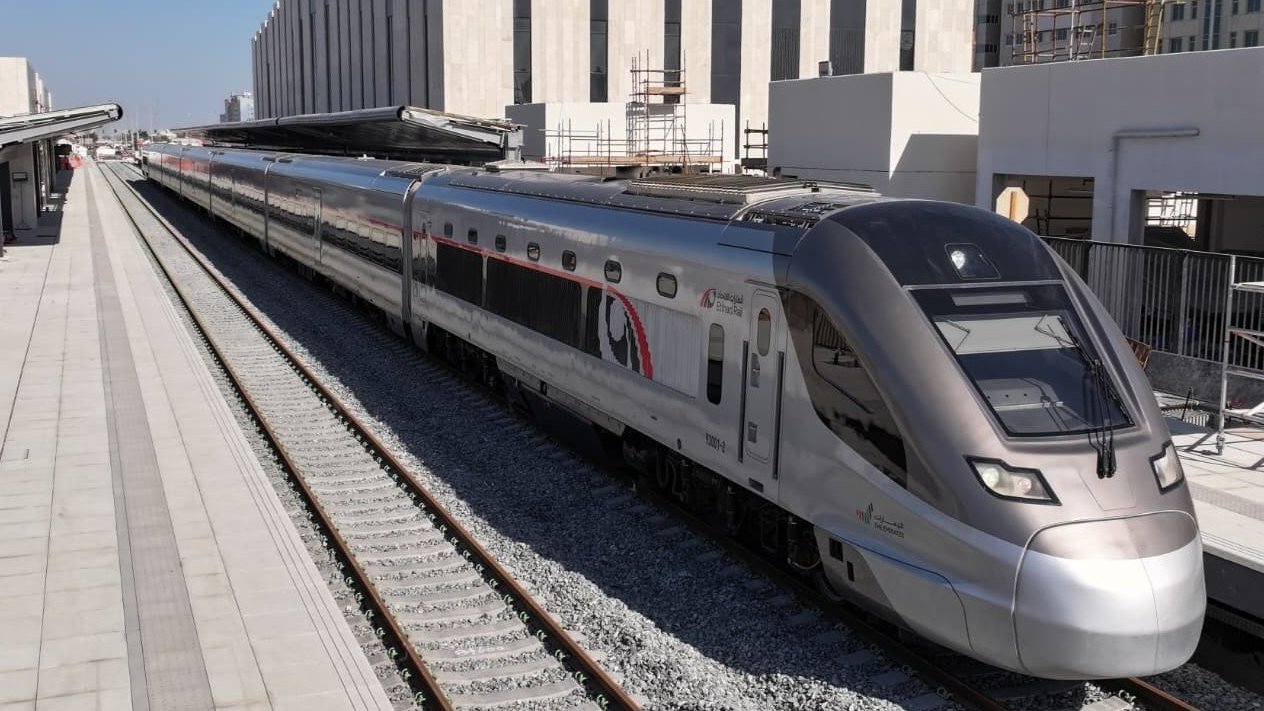
On Wednesday 30 September 2026, Etihad Rail, the UAE national railway, began running passenger trains between Dubai and Abu Dhabi. The first train left Dubai’s Al Yalayis station for Abu Dhabi at 6:14 am.
Until now, travel between UAE cities has depended almost entirely on cars and buses. A railway linking the emirates in about an hour could change how people live, work, travel — even where they choose to live. This guide covers today’s fares and timetable, and also explains what Etihad Rail is, where its stations are, how it got here and where it is heading.
What Etihad Rail is: the UAE’s national railway
Etihad Rail is both the UAE’s national railway company and the name of the network it builds. It was established in 2009 under Federal Law No. 2 of 2009, is headquartered in Abu Dhabi and is chaired by Sheikh Theyab bin Mohamed bin Zayed Al Nahyan.
It began life as a freight railway, a logistics backbone linking ports, industrial zones and the Saudi border. From 2026, passenger trains started running on the same network.
| Founded | 2009 (Federal Law No. 2 of 2009) |
|---|---|
| Network | About 900 km (around 1,200 km planned) |
| Passenger trains | Up to 200 km/h, about 400 passengers per train |
| Passenger stations | 11 cities and regions across four emirates: Abu Dhabi, Dubai, Sharjah and Fujairah |
| Passenger outlook | A target of around 10 million a year; a projection of 36.5 million a year by 2030 has also been published |
How it got here: from freight line to passenger railway
| When | Milestone |
|---|---|
| June 2009 | Etihad Rail established by federal law |
| January 2016 | Stage 1 (264 km) opens, carrying granulated sulphur for ADNOC from the Shah and Habshan gas facilities to Ruwais port (up to 22,000 tonnes a day) |
| February 2023 | Stage 2 (605 km) completed, linking Ghuwaifat on the Saudi border to Fujairah on the east coast; the network reaches about 900 km |
| 30 June 2026 | Passenger service begins between Abu Dhabi and Fujairah; more than 10,000 tickets sold before launch |
| 30 September 2026 | Dubai (Al Yalayis) and Al Dhaid in Sharjah open; Dubai–Abu Dhabi trains begin |
Sources: Wikipedia “Etihad Rail”; The National (28 September 2026).
Roughly a decade separates the first freight trains from the first passenger services: the network proved itself with cargo, its main line from the Saudi border to Fujairah was completed, and only then did it open to passengers.
Launched today: Dubai–Abu Dhabi fares and timetable
To mark the launch, Sheikh Hamdan bin Mohammed bin Rashid Al Maktoum, Crown Prince of Dubai, and Sheikh Theyab bin Mohamed bin Zayed Al Nahyan inaugurated the Dubai station, and President Sheikh Mohamed bin Zayed travelled on the inaugural train from Abu Dhabi to Dubai.
| Route | Dubai (Al Yalayis station) – Abu Dhabi (Mohamed Bin Zayed City station) |
|---|---|
| Journey time | About 1 hour (reported as 57–64 minutes) |
| Frequency | Five trains a day in each direction |
| Fares | Comfort class from AED 39 / Premium class from AED 109 |
| Fare types | Saver (non-refundable, no seat selection) / Value (changes allowed) / Flex (fully flexible, including refunds) |
| Booking | etihadrail.ae, the Etihad Rail app or station ticket machines, up to 5 minutes before departure; integrated with Dubai’s Nol, so one QR code covers train, Metro, tram and bus |
| Service | From Dubai | From Abu Dhabi |
|---|---|---|
| 1st | 6:14 | 6:43 |
| 2nd | 7:14 | 7:43 |
| 3rd | 13:14 | 12:43 |
| 4th | 17:14 | 16:43 |
| 5th | 18:14 | 17:43 |
Departure times at launch. Source: Gulf News (September 2026). Times may change.
The 6 am and 7 am departures suit a Dubai-to-Abu Dhabi commute. With few trains in the middle of the day, it is worth booking your return journey in advance.
Where are the stations? All 11 and when they open
Passenger stations serve 11 cities and regions, seven of them in the emirate of Abu Dhabi — including a string of stops across its vast western region, Al Dhafra.
| Station | Emirate / area | Opening |
|---|---|---|
| Mohamed Bin Zayed City | Abu Dhabi (opposite Dalma Mall) | Open (30 June 2026) |
| Al Hilal (Madinat Al Hilal) | Fujairah | Open (30 June 2026) |
| Jumeirah Golf Estates (Al Yalayis) | Dubai | Open (30 September 2026) |
| Al Dhaid | Sharjah | Open (30 September 2026) |
| Madinat Zayed | Abu Dhabi (Al Dhafra) | Due 30 November 2026 |
| Mezairaa | Abu Dhabi (Al Dhafra, Liwa area) | Due 30 November 2026 (announced as “Liwa”) |
| Al Sila | Abu Dhabi (Al Dhafra) | Due 30 December 2026 |
| Al Dhannah | Abu Dhabi (Al Dhafra) | Due 30 December 2026 |
| Al Mirfa | Abu Dhabi (Al Dhafra) | Due 30 December 2026 |
| University City | Sharjah | Due 30 March 2027 |
| Al Faya | Abu Dhabi | Not yet announced |
Sources: Gulf News (January 2026, updated April 2026); The National (28 September 2026). Dates may change.
Dubai: getting to Al Yalayis
- Metro: a 400 m covered footbridge links it to Jumeirah Golf Estates station on the Red Line (about a 5-minute walk), with a Gold Line connection planned for 2032
- Bus: route F38 serves the station area, linking Dubai Production City and Dubai Sports City
- Car: 265 paid parking spaces (5 for electric vehicles)
- Facilities: Wi-Fi, waiting areas including a family waiting area, a first-aid room, ticket machines, and food and retail such as Starbucks and WHSmith
Abu Dhabi: onward from Mohamed Bin Zayed City
The station sits opposite Dalma Mall, next to Mussafah Bus Station — not in central Abu Dhabi. AD Mobility buses MR1 and MR2 run to the Main Bus Station and Al Zahiyah, and there are Etihad Rail shuttle buses (AED 10 per trip) and taxis. Add the onward leg to the hour on the train when you plan.
What changes when the emirates are linked
The UAE is a federation of seven emirates, yet crossing between them has mostly meant driving or taking the bus. With the railway, travelling between emirates is becoming an everyday option. Reported journey times for the main routes:
| Route | Journey time | Fare from |
|---|---|---|
| Dubai – Abu Dhabi | About 1 hour | AED 39 |
| Dubai – Fujairah | About 70 minutes | AED 29 |
| Abu Dhabi – Fujairah | About 105 minutes | — |
| Abu Dhabi – Ruwais | About 70 minutes | — |
| Al Dhaid (Sharjah) – Abu Dhabi | About 84 minutes | AED 59 |
| Al Dhaid – Fujairah | About 25 minutes | AED 19 (morning) |
Comfort-class fares. Sources: The National (28 September 2026); Gulf News (January 2026). “—” = fare not confirmed. Dubai–Fujairah departs 11:54 from Dubai and 13:57 from Fujairah.
- Living in one emirate, working in another: living in Dubai and working in Abu Dhabi — or the reverse — becomes realistic without a car; the 6 am and 7 am trains fit a commute
- Weekend escapes: Fujairah on the east coast is about 70 minutes from Dubai, from AED 29 — the mountains and sea of the east coast are now reachable by train (for now trains leave Dubai at 11:54 and Fujairah at 13:57, so check the timetable before planning a day trip)
- Reaching the west: Ruwais, an industrial hub, is about 70 minutes from Abu Dhabi, and more Al Dhafra stations — including Liwa — are due to open
- Easier connections: in Dubai, integration with Nol means one QR code takes you from the train to the Metro, tram and bus
| Option | Fare | Time |
|---|---|---|
| Etihad Rail (Comfort) | From AED 39 | About 1 hour + station transfers |
| Bus (Ibn Battuta → Abu Dhabi Central) | AED 25 | About 105 minutes |
| Taxi | Typically AED 330–420 | — |
Dubai–Abu Dhabi comparison. Source: The National (30 September 2026).
The train costs AED 14 more than the bus but is over 40 minutes quicker on board, and roughly a tenth of a taxi fare. The closer you live to a station — and the shorter your onward trip — the more it pays off.
What comes next: high-speed rail, Oman and the GCC railway
At home: more stations and the northern emirates
Madinat Zayed and Liwa are due on 30 November 2026, Al Sila, Al Dhannah and Al Mirfa on 30 December 2026, and University City in Sharjah on 30 March 2027. A third stage (279 km) running from Dubai towards the northern emirates, including Ras Al Khaimah and Fujairah, has also been proposed, but no timeline has been set.
High-speed rail: Abu Dhabi to Dubai in about 30 minutes
Separately from today’s line, a high-speed railway of about 150 km, running at up to 350 km/h and linking Abu Dhabi and Dubai in about 30 minutes, is planned for 2030. Reports put its capacity at up to 21 million passengers a year and its contribution to GDP at AED 145 billion over 50 years.
Hafeet Rail: from Al Ain to Sohar in Oman
Hafeet Rail, a UAE–Oman joint venture (about 238 km, US$2.5 billion), will connect Sohar in Oman to the UAE network via Al Buraimi and Al Ain. Construction was about 40% complete in April 2026, and Oman ratified the agreement in September. Passenger trains will run at up to 200 km/h, with Sohar–Abu Dhabi in about 100 minutes and Sohar–Al Ain in about 47 minutes.
The GCC railway: linking six Gulf states
Etihad Rail already reaches Ghuwaifat on the Saudi border and forms part of the GCC railway, which aims to link all six Gulf Cooperation Council states; the Gulf Railway Authority is targeting December 2030. Travelling by train to Saudi Arabia or Oman is now on the horizon.
The expected impact
Projections published for the network point to the following economic and environmental effects. They are long-term estimates, not guarantees.
- Economic benefits of AED 186 billion over 40 years
- Cutting CO2 emissions by more than 2.2 million tonnes a year — equivalent to taking up to 375,000 vehicles off the roads
- Tourism revenue of AED 21 billion over 40 years
- A AED 23 billion uplift in land values over 50 years
Beyond the numbers, the bigger shift may be that daily life, long organised emirate by emirate, starts to function as one connected country. Choosing where to live, work and spend your weekends across emirate lines is a real change — for residents and for anyone considering moving to or investing in the UAE.
A property view: what the stations mean
On the Dubai side, Al Yalayis sits next to Jumeirah Golf Estates, connects to the Metro Red Line by footbridge and is linked by bus to Dubai Sports City and Dubai Production City. Areas with easy station access — in either city — become worth considering for people splitting their lives between the two.
That said, a new station alone is not a reason to expect prices to rise. There are only five trains a day for now, and the Abu Dhabi station is outside the centre. Check how the service works for you in practice — frequency, the transfer at each end and the route of the future high-speed line — before letting it drive a decision.
If you would like to compare homes near the stations, or weigh up living in Dubai versus Abu Dhabi, get in touch — we are a Japanese-run agency working in Japanese, English and Arabic.
FAQ
What is Etihad Rail?
The UAE national railway company, founded in 2009, and the network it runs. It started as a freight railway and has carried passengers since June 2026. The network is about 900 km long, with around 1,200 km planned.
How much is Dubai–Abu Dhabi, and how long does it take?
From AED 39 in Comfort class and AED 109 in Premium class, taking about an hour (reported as 57–64 minutes), with five trains a day each way at launch.
Where are the stations?
Mohamed Bin Zayed City (Abu Dhabi), Al Hilal (Fujairah), Jumeirah Golf Estates / Al Yalayis (Dubai) and Al Dhaid (Sharjah) are open. The Al Dhafra stations and University City in Sharjah are due between November 2026 and March 2027; Al Faya (Abu Dhabi) has no date yet. That makes 11 cities and regions in total.
Where can I buy tickets?
On etihadrail.ae, in the Etihad Rail app or at station ticket machines, up to 5 minutes before departure. The service is also integrated with Dubai’s Nol system.
Where will the railway go in future?
More stations are coming in Al Dhafra and at Sharjah’s University City. Beyond that: a high-speed line linking Abu Dhabi and Dubai in about 30 minutes (target 2030), Hafeet Rail to Sohar in Oman via Al Ain, and the GCC railway linking six Gulf states (target December 2030).
Will property near the stations go up in value?
Not necessarily — a station alone does not guarantee a rise. Look at how usable the service is in practice (frequency, transfers, future routes) before deciding, and feel free to ask us to compare specific properties.
This article is based on reporting as of 30 September 2026 (The National, 28 and 30 September 2026; Gulf News, January–September 2026), the Etihad Rail website (etihadrail.ae) and the Wikipedia entry “Etihad Rail”. Economic figures are projections as published. Timetables, fares and opening dates may change — please check the official website before you travel.