

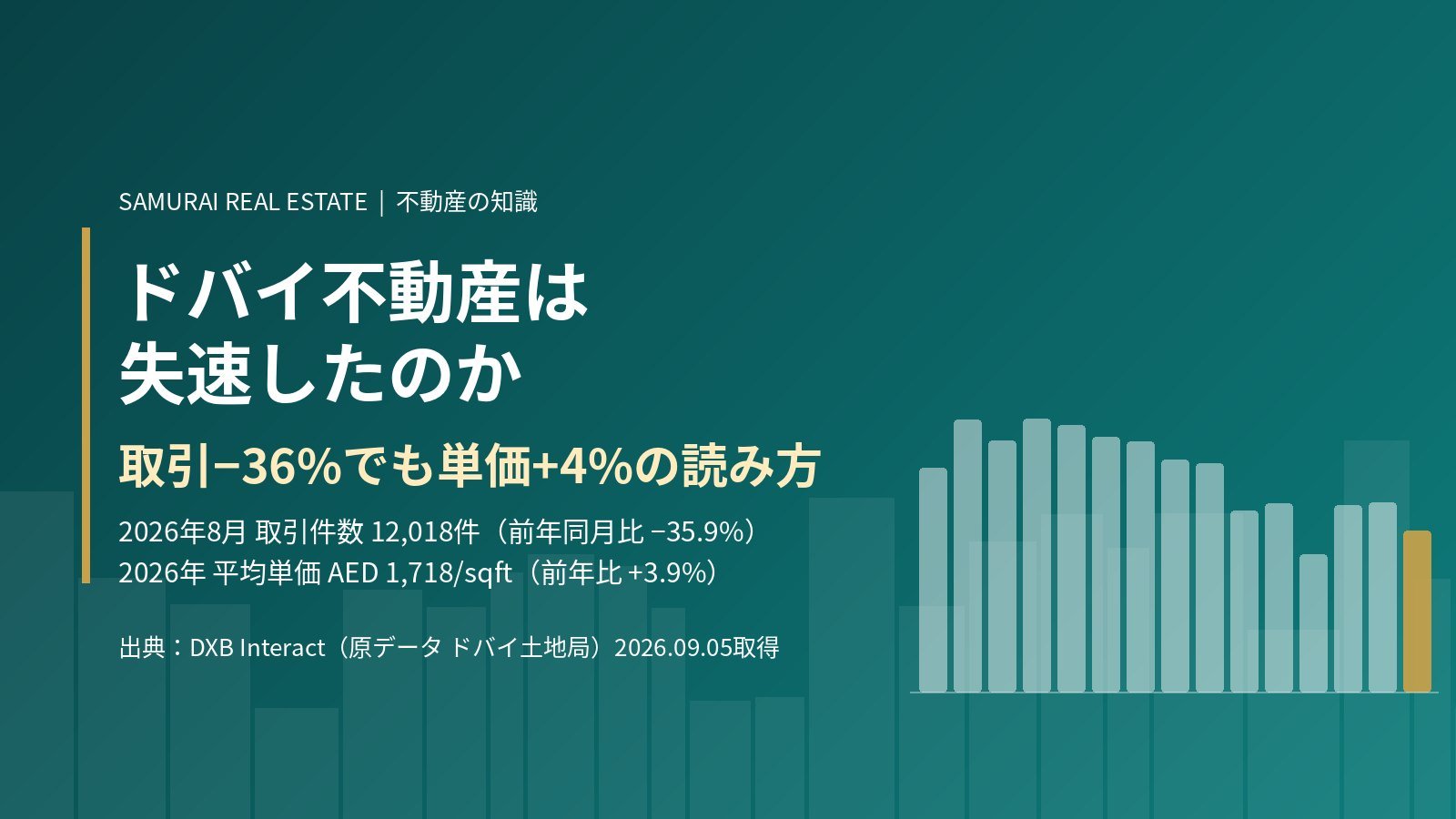
“Is Dubai property about to turn?” Since the summer of 2026 we have been asked this far more often — and the trigger is a number. Dubai registered 12,018 property sales in August 2026: down 35.9% from 18,749 in August 2025 and down 15.0% on July, the second-weakest month of the year after May.
Yet the same data, read from another angle, shows the 2026 average price still at AED 1,718 per sqft, up 3.9% year on year. Volumes collapsing while prices rise: those two seemingly contradictory numbers are the real state of the Dubai market today. In this article we use Dubai Land Department (DLD) registration data as compiled by DXB Interact (retrieved 5 September 2026) to locate the market at three resolutions — monthly, quarterly and by community — and set out decision rules for buyers, sellers and holders. The short version: this is no longer a market where anything you buy goes up — it is a market for selecting the properties that can still make money.
Fact 1: where volumes broke
From the September 2025 peak of 20,308 sales to 12,018 in August 2026 is a fall of roughly 41%. January and February held above 17,000; March dropped a step to 13,501, and May sank to 10,279 — within sight of the 10,000 line.
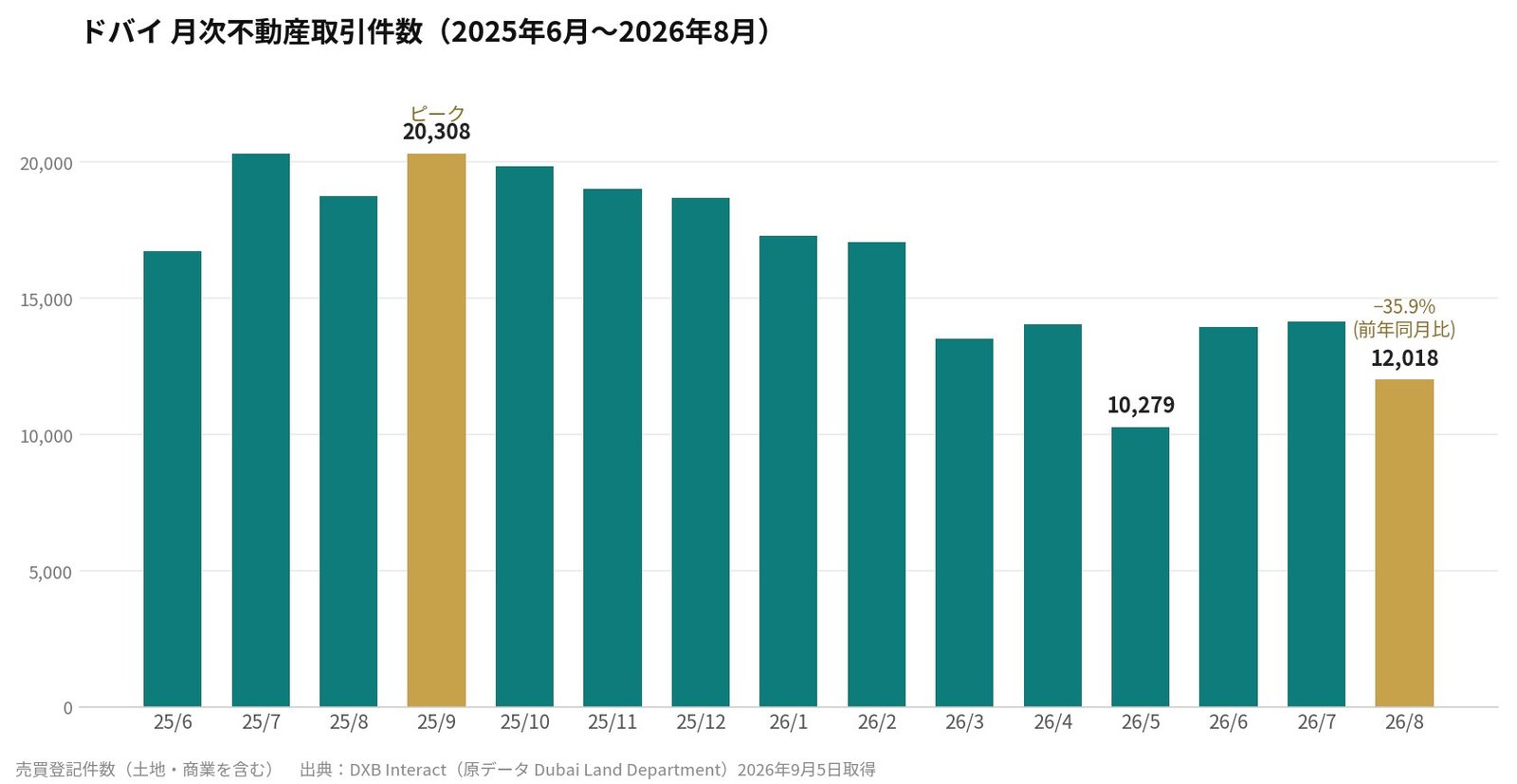
Monthly sales registrations (including land and commercial). After the September 2025 peak, volumes have sat on a lower shelf since March 2026. Source: DXB Interact (DLD data), retrieved 5 September 2026.
| Sales, August 2026 | 12,018 (−15.0% on July / −35.9% year on year) |
|---|---|
| Sales, January–August | 112,239 (137,765 a year earlier, −18.5%) |
| Sales value, January–August | AED 349.8 billion (AED 444.7 billion a year earlier, −21.3%) |
| Average deal size, August | AED 2.38 million (AED 2.73 million in August 2025) |
Summer is always quieter, but a 36% year-on-year drop in August is not seasonality. Comparing the same January–August window across years, 2026’s 112,239 sales are not only below the record 2025 (137,765) — they are slightly below the same period of 2024 (113,269) as well.
Calling it a crash would be inaccurate, though. Sales value of AED 349.8 billion is still above the same period of 2024 (AED 332.2 billion), so the fairer reading is normalisation from the abnormal highs of 2025. On top of that came an external shock, described next.
What happened in March, when volumes broke: the Middle East factor
The timing tells the story. Volumes had been running above 17,000 in January and February; the direct trigger for the step down in March was the Iran war that began on 28 February 2026. In retaliation for US–Israeli strikes on Iran, Iran fired missiles and drones at Gulf states including the UAE, and debris fell in urban Dubai. A ceasefire took hold on 8 April and attacks on the UAE stopped after a sporadic incident in May, but the US–Iran ceasefire collapsed in July and tensions persist — more than enough to keep international buyers in wait-and-see mode.
In other words, the slowdown is not demand disappearing; it is buyers pausing because of a geopolitical shock. After the ceasefire, June and July recovered to the 13,900–14,100 range from May’s low of 10,279. August’s 12,018 also carries the usual summer lull, so the pace of recovery from autumn is the next thing to watch. Read the figures below with that context in mind.
Fact 2: prices are still up — but the quarterly picture has turned
The annual average price per sqft has risen for six straight years from the 2020 trough (AED 916) to AED 1,718 in 2026 — +88% cumulatively. But the pace shrinks every year.
| 2023 | +14.2% (AED 1,367) |
|---|---|
| 2024 | +11.6% (AED 1,526) |
| 2025 | +8.4% (AED 1,654) |
| 2026 (year-to-date average) | +3.9% (AED 1,718) |
And at quarterly resolution the reversal of 2026 appears. Apartments peaked at AED 1,762 in Q3 2025, then slipped to 1,749 in Q1 2026 and 1,714 in Q2 (−2.7% from peak). Villas fell harder: from a peak of AED 1,526 to 1,434 in Q1 and 1,403 in Q2 (−8.1% from peak).
Villas jumped 11.5% quarter on quarter in Q3 2025 and have now given ground for two quarters in a row; contracts signed at the late-2025 highs may already sit above today’s clearing prices. Seller-side material tends to quote the annual “+3.9%”, but the direction of the last two quarters is the opposite. If someone tells you Dubai is still rising, ask for the quarterly numbers.
The mechanics of “prices up, volumes halved”
Comparing apartments in the 13 major communities over the last 12 months (6 September 2025–5 September 2026) with the previous 12 months makes the pattern plain.
| Community | AED/sqft | Price YoY | Sales | Sales YoY |
|---|---|---|---|---|
| Jumeirah Village Circle | 1,484 | +8% | 14,657 | −11% |
| Dubai South | 1,608 | −1% | 10,443 | +48% |
| Business Bay | 2,570 | +10% | 10,190 | −3% |
| Dubai Creek Harbour | 2,528 | +4% | 4,527 | +8% |
| Downtown Dubai | 3,102 | +11% | 3,211 | −24% |
| Dubai Marina | 2,149 | −1% | 2,834 | −51% |
| Dubai Hills Estate | 2,354 | +1% | 2,219 | −53% |
| Town Square | 1,536 | +18% | 2,169 | −2% |
| Palm Jumeirah | 3,466 | +27% | 1,341 | −11% |
| Damac Hills | 1,570 | +22% | 1,337 | +30% |
| Sobha Hartland | 2,045 | +3% | 1,168 | −4% |
| Emaar Beachfront | 3,639 | −12% | 469 | −50% |
Apartments, primary + resale combined, last 12 months vs prior 12 months. Source: DXB Interact “Area Performance” (DLD data), retrieved 5 September 2026. Thinly traded Palm Jebel Ali excluded.
Of the 12 areas in the table, prices are up year on year in nine. But sales volumes are up in only three — Dubai South (+48%), Dubai Creek Harbour (+8%) and Damac Hills (+30%). In Dubai Marina, Dubai Hills Estate and Emaar Beachfront, transactions have halved.
With buyers thin on the ground, a small number of deals is setting the price. That is what “prices held, volumes halved” really means — and it is why reading a rising price per sqft as “strong demand” is dangerous in this phase.
Who is selling: AED 37.9 billion of realised gains (+63%)
One more number is hard to ignore. Year to date, realised capital gains on resale transactions (owner-to-owner sales) total AED 37.9 billion, up 62.9%. Transactions are down by roughly 30%, yet realised profit is up 60%. In other words, owners who bought cheaply in 2021–2023 are locking in their gains and exiting now.
From the buyer’s side, a large share of recent deals involves sellers who want to crystallise a paper gain. Room to negotiate on price is wider now than at any point in the last two years.
By segment: villa primary sales fell hardest
| Segment | Jan–Aug 2025 | Jan–Aug 2026 | Change | August YoY |
|---|---|---|---|---|
| Apartments — primary | 73,585 | 66,804 | −9.2% | −41.2% |
| Apartments — resale | 32,184 | 23,409 | −27.3% | −21.9% |
| Villas/townhouses — primary | 17,117 | 9,631 | −43.7% | −39.2% |
| Villas/townhouses — resale | 8,472 | 5,938 | −29.9% | −23.6% |
Residential only. “Primary” = first sale by the developer (mostly off-plan); “resale” = owner-to-owner. Source: DXB Interact “Cycles — Monthly” (DLD data).
Apartment primary sales are holding up best (−9.2%); villa primary sales have fallen furthest (−43.7%). Resale is down about 30% for both apartments and villas, and in August alone all four segments were at least 20% below the prior year.
Primary sales now account for 72% of residential transactions — not because primary grew, but because resale shrank faster. A plan that relies on flipping an off-plan unit for a quick gain at handover is hard to make work in today’s liquidity.
By contrast, the rental market is moving
Sales and rentals are moving in opposite directions. Ejari rental contracts in freehold areas (new + renewals) totalled 289,208 in January–August 2026, up 4.5% year on year. August alone saw 39,645 contracts (+11.7%), more than three times the month’s sales count.
The median rent, however, was AED 72,000 in August 2026 against AED 72,210 a year earlier — essentially flat. More contracts, no rent growth: tenants are there, but they are not paying more.
The new-lease premium has shrunk from 21% to 12%
In Dubai, rent increases at renewal are capped by the RERA rental index, while a new lease to a new tenant is not. That gap — the “new-lease premium” — has been a hidden advantage of off-plan investment, since a newly completed unit starts life on new-lease rents. For apartments in 2026 the premium has halved from +21.4% in February to +12.0% in August: the median new-lease rent slipped from AED 68,000 to 64,722 while renewals trended up from AED 56,000 to 57,791.
New-lease rents reflect what tenants will pay today. The fact that they are falling is the most important signal that rents are approaching a ceiling. It is worth checking whether the projected rent in a developer’s brochure assumes the new-lease levels of early 2026.
Four decision rules for investors right now
1. Check prices by quarter, not by year
The annual +3.9% is real, but Q2 2026 was −2.0% for apartments and −2.2% for villas quarter on quarter, and villas have nearly given back their entire Q3 2025 surge (+11.5%). For any area you are considering, check the direction of the last two quarters first.
2. Favour areas where volumes hold, not just where prices rise
Over the last three months (6 June–5 September 2026), only Dubai South among the 13 major communities increased its transaction count (+87%, mostly primary sales); seven areas fell by 40% or more. Even where prices rose, the number of deals closing at those prices is roughly half what it was. Put the last three months of sales in your target area next to the previous three and the same period last year.
3. Budget twice the usual time to sell
With resale transactions down about 30%, it is realistic to budget twice the usual selling time — roughly 6 to 12 months. Be especially careful buying with money you will need on a fixed date within a few years. On the other hand, cash deals make up two-thirds of the market (67%), a structure that limits forced selling in a downturn. Mortgages tell a mixed story: transactions −10%, but value +12% and average LTV 75.7% — fewer borrowers, borrowing more — so this cohort’s support would weaken if rates or valuations changed.
4. Buy on today’s rent level, not on expected rent growth
Now that median rents have flattened, a property whose yield does not work at today’s rent cannot be rescued by future rent growth. “It will let for more once it is finished” carries little weight while new-lease rents are lower than they were in January.
By community: yield × price momentum in four groups
Here are the major communities’ apartments sorted by resale gross yield and the direction of prices over the last three months. Yields are DXB Interact’s figures, before service charges and other costs.
| A · High yield × prices rising | Dubai South 8.3% / +8%; Dubai Marina 5.9% / +12% |
|---|---|
| B · High yield × prices flat or softening (income buyers’ hunting ground) | JVC 7.3% / −6%; Business Bay 6.8% / −7%; Damac Hills 6.3% / 0%; Sobha Hartland 6.1% / −1%; Town Square 5.9% / −5% |
| C · Low yield × prices rising (growth already priced in) | Dubai Creek Harbour 5.3% / +1%; Emaar Beachfront 4.6% / +4%; Palm Jumeirah 4.4% / +1% |
| D · Low yield × prices flat or softening (no reason to hurry) | Dubai Hills Estate 5.7% / 0%; Downtown Dubai 4.9% / −2% |
Dubai South has the highest yield of the major areas, but the flip side is a pipeline of 37,020 units (62% sold) — the second largest — and a transaction mix dominated by primary sales. JVC has the biggest pipeline at 38,269 units. Sobha Hartland, Dubai Creek Harbour and Dubai Marina, by contrast, have pipelines equal to only 1.4–1.9 years of current sales, which makes them less exposed to the rent and resale pressure that comes with clustered handovers.
Remember that gross yield still has to absorb annual service charges (roughly AED 10–25 per sqft), management fees (5–8% of rent) and void periods; a gross 7% typically nets around 5%. And 63% of rental contracts are for studios and one-bedrooms — the deepest pool of tenants is in small units.
There are still properties that can make money — how to think in a “selection phase”
The figures so far are risk disclosure, but our conclusion is not “don’t buy”. The phase in which the whole market was lifted is over; what has begun is a selection phase, where results are decided by how well you choose. In fact, several conditions for making money exist precisely because of the current environment.
- In resale: with more sellers keen to lock in gains, negotiating room is the widest in two years. Buy a small unit in a community with deep rental demand below the going rate and the yield works from day one — with capital gain available when the market turns back up.
- Off-plan (primary): the narrowing new-lease premium (+12%) and primary-to-resale price gap also mean the risk of overpaying for new stock has fallen. Pick a project in a supply-thin community (around 1.5 years of pipeline) whose handover does not coincide with its neighbours’, and upside against resale prices at completion still remains, if smaller than before.
- Realising profit on exit: even in a thin market, some communities are growing their transaction counts — Dubai South (+48%), Dubai Creek Harbour (+8%) and Damac Hills (+30%) overall, and Sobha Hartland (+11%) and Town Square (+10%) on resale alone — and properties there are still finding buyers. Choosing an area with a working exit from the outset is the shortest route to locking in a resale profit in this market.
Which specific projects and units meet these conditions changes with timing and budget. We put forward candidates individually on the basis of the data above — get in touch for details.
Conclusion: from “choose well and it rises” to “how well you choose decides”
As of September 2026, Dubai is a market where prices are holding high, transactions are temporarily thin because of the regional situation, and rentals are active but rents are not growing. A year ago the story was “choose well and it rises”; it has moved on to “how well you choose decides the result.” By position:
- If you are buying: watch volumes, not just price per sqft. With many sellers keen to lock in gains, negotiating room is wide — choose a unit whose yield works at today’s rent in an area with a working exit, and this is a good phase to be accumulating.
- If you are selling: price to the latest clearing levels, especially for villas. A price anchored to the annual +3.9% may sit unsold for 6–12 months.
- If you are holding: rental demand is solid (contracts +4.5%), so this is not a moment to rush an exit. But do not plan on rent growth, and check renewal rents against the RERA rental index.
We advise on buying, selling and holding using market analysis updated monthly from DLD registration data, plus comparative market analysis (CMA) for individual communities. For a specific question — “which properties can still make money now?”, “should I buy this unit?”, “what should I list at?” — reach us on WhatsApp or through the contact form.
Frequently asked questions
Are Dubai property prices falling in 2026?
The annual average price per sqft is still up 3.9% year on year, but on a quarterly basis apartments are 2.7% below their Q3 2025 peak and villas 8.1% below. Sales volumes fell 36% year on year in August 2026. Prices are holding high while transactions thin out.
Why are transaction volumes falling?
The direct trigger was the Iran war that began on 28 February 2026. Missiles and drones reached the UAE, international buyers moved to wait-and-see, and volumes that had run above 17,000 in January–February stepped down from March (ceasefire 8 April, though the US–Iran truce collapsed in July and tensions persist). Layered on top: buyers had already become cautious at high price levels; owners who bought in 2021–2023 are selling to realise gains (AED 37.9 billion year to date, +63%); and owner-to-owner resale has fallen much more than primary sales (apartments −27%, villas −30%).
Is now a good time to buy in Dubai?
It is not a market where anything you buy goes up, but for a selective buyer it is a good phase to accumulate. Sellers realising gains give you wide negotiating room, and a unit whose yield works at today’s rent — or one in a supply-thin community with a working exit — leaves capital gain on the table for when the market turns back up. Off-plan still offers upside if you pick a project whose handover does not coincide with its neighbours’. It is not suited to a pure short-term flip. Ask us for specific candidates.
If I let my property, will rents keep rising?
It is safer not to assume so. Dubai’s median rent was AED 72,000 in August 2026, essentially flat year on year, and new-lease rents fell from AED 68,000 in February to AED 64,722 in August. Demand itself remains solid, with contract numbers up 4.5% in January–August.
Is off-plan (primary) still the better deal?
The advantage remains but is narrowing. Primary prices are 12% above resale (down from +28% in 2021), so the room to “catch up” with resale prices by handover is smaller than before, and the new-lease premium has halved from +21% to +12%. In supply-heavy areas such as JVC (38,269 units) and Dubai South (37,020), watch for clustered handover dates.
What should an overseas investor watch most closely?
The exit. Avoid buying with money that must be returned by a fixed date, and budget 6–12 months to sell. Your return in home currency will also swing with the AED exchange rate. Before committing, check the last three months of sales in your target community and confirm that the yield works at today’s rent.
This article is general information based on public data as of 13 September 2026 (Dubai Land Department registration data and Ejari rental data as compiled by DXB Interact, retrieved 5 September 2026, plus published reporting on the regional situation). It is not investment, legal or tax advice. Community-level figures cover DXB Interact’s major-community classification only, and thinly traded areas can swing on a single deal. Yields are gross, before service charges, management fees and voids. Market data is revised without notice — always verify the latest position before making decisions.