


Beachfront on Saadiyat. Marina views on Yas. Waterfront towers on Al Reem. Abu Dhabi property marketing is saturated with water — and it almost always arrives with the same line: “waterfront is scarce, so it will appreciate.”
This article tests that claim. The short answer: Abu Dhabi waterfront is genuinely appreciating — Saadiyat apartments rose 21% year on year in H1 2026. But scarcity is not what produced that rise. And in the same year, another stretch of island waterfront fell 22%. Understanding where that gap comes from is what actually matters when you buy water in this city.
The facts: Abu Dhabi waterfront really is rising
According to Knight Frank, Abu Dhabi recorded AED 117 billion (about USD 31.9 billion) in transactions in H1 2026, up 112% year on year, across 16,838 deals (+61.7%) — records on both counts. What matters here is which place names top the price-growth table.
| Saadiyat Island (apartments) | +21% YoY at AED 43,100/sqm — the city’s most expensive waterfront |
|---|---|
| Yas & Al Reem Islands (apartments) | +18% YoY |
| Al Jubail Island (villas) | +40% YoY — a low-rise, mangrove-fringed new waterfront |
| Al Reem Island (villas) | −22% YoY — the only decline. A 62-point gap from Jubail, both island waterfront |
| Waterfront pipeline (2026–30) | ~36,900 units (Yas 7,700 / the new Fahid Island 3,550 / Saadiyat 3,250) |
Source: Knight Frank, July 2026. Every place name in that table is an island. So yes — Abu Dhabi’s price growth is happening on the water, exactly as the brochures say. The problem is the fourth row: Jubail +40% against Al Reem −22%, both island villas. If “waterfront, therefore up” were true, that 62-point gap could not exist.
Why the waterfront scarcity premium does not work here
Property price theory is simple: prices compound when demand concentrates on a location that cannot be reproduced. Waterfront commands a premium worldwide because coastline is finite. In Abu Dhabi, that premise falls apart.
Reason 1: 200+ islands keep supplying “the next waterfront”
The emirate of Abu Dhabi comprises more than 200 natural islands (official UAE government figure): Saadiyat, Yas, Reem, Jubail, Fahid, Hudayriyat, and on it goes. Developable waterfront is still sitting on the map, unbuilt.
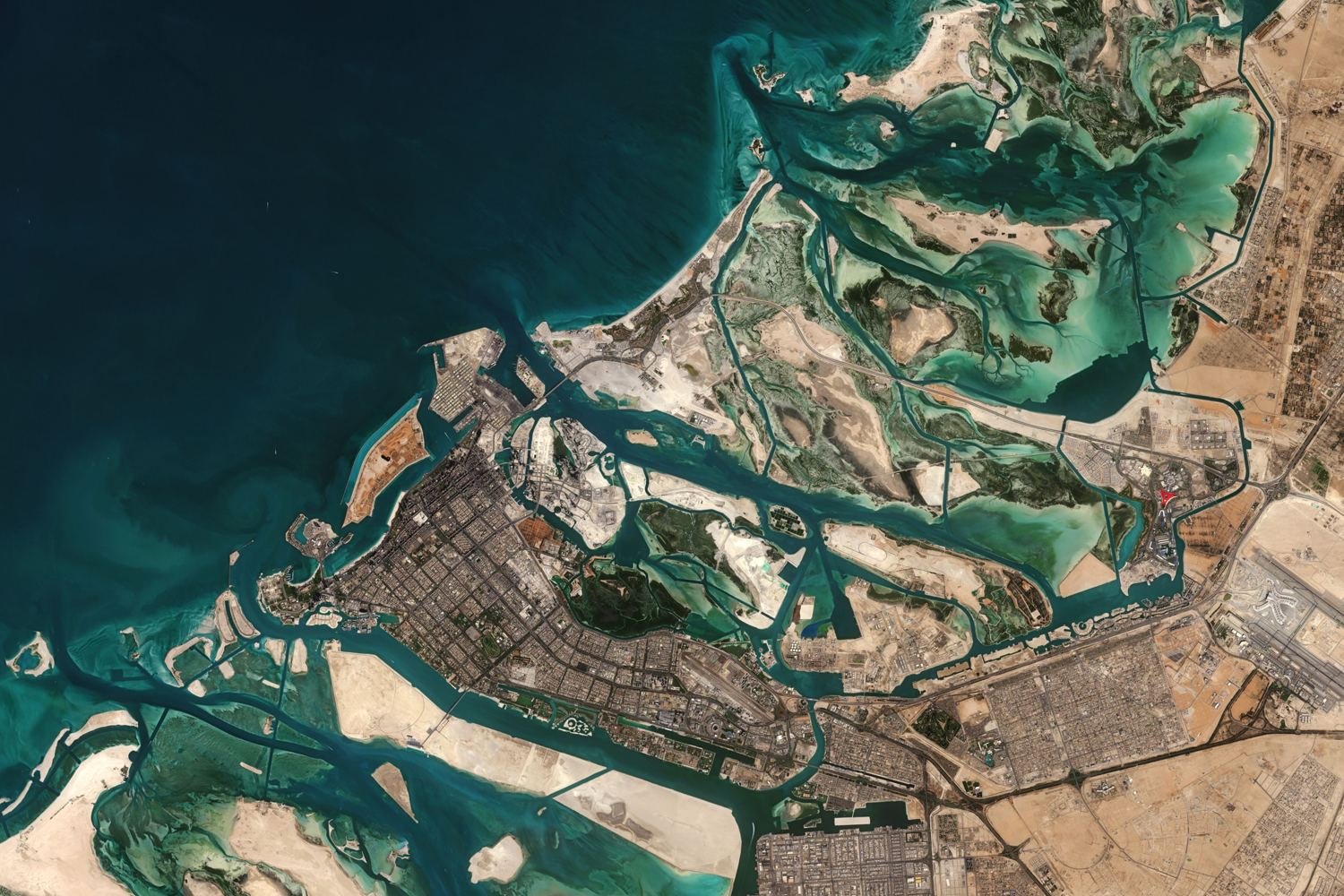
Abu Dhabi from above: the city itself is a lattice of islands and inlets, so “by the water” is everywhere — one image that explains why waterfront scarcity struggles to take hold here.
The pipeline confirms it. Of the ~36,900 units due for completion between 2026 and 2030:
- about 7,700 units on Yas Island alone — a large block of new marina and beach frontage
- about 3,550 units on Fahid Island — an entirely new island, and therefore an entirely new waterfront, rising between Saadiyat and Yas
- and about 3,250 more units on Saadiyat, the priciest waterfront in the city
In other words, a newer waterfront will open next door to the one you buy today. Your sea view is not scarce; it is replaceable — that is the structural fact underneath Abu Dhabi waterfront.
Reason 2: There is unlimited land on which to build more waterfront
It is not only the island count. Abu Dhabi is a city with a surplus of land itself. The emirate covers 67,340 sq km — about 16 times Dubai’s ~4,114 sq km — while housing roughly the same number of people: 4.14 million (2024, Statistics Centre Abu Dhabi) against Dubai’s ~3.94 million. That is about 61 people per sq km versus roughly 960.
| Land area | Dubai ~4,114 sq km — Abu Dhabi 67,340 sq km (~16×) |
|---|---|
| Population | Dubai ~3.94m (2026) — Abu Dhabi 4.14m (2024, SCAD); different reporting years, but the same order of magnitude |
| Population density | Dubai ~960/sq km — Abu Dhabi ~61/sq km (~1/16th) |
| Natural islands | Abu Dhabi: 200+ (official) — Dubai’s waterfront is mainly man-made islands |
This is supply elasticity. Where land is scarce, rising demand for water cannot be met with more supply, so it flows straight into price. Where land and islands are effectively unlimited, extra demand for waterfront is absorbed by new waterfront development instead of higher prices. Livable land does cluster on the coast, of course — but the mere fact that the government can designate “the next island” puts a ceiling on how far existing waterfront stock can climb.
Reason 3: What made Palm Jumeirah different
For contrast, consider the most successful man-made waterfront in the world. Palm Jumeirah became an icon because Dubai built an address on the water where usable coastline was scarce. Its sister project, Palm Jebel Ali, was planned as far back as 2002 — but it stalled after the 2008 financial crisis and was only relaunched in 2023. Palm Jumeirah therefore stayed effectively one of a kind for roughly two decades, and it was the length of that irreplaceable window that compounded its prices.
Abu Dhabi waterfront gets no such window. Fahid follows Yas, and something follows Fahid. The price engine here is not scarcity but state-led demand creation: the Saadiyat Cultural District (Zayed National Museum and the Guggenheim following the Louvre Abu Dhabi), and Disneyland Abu Dhabi, announced in 2025 for Yas Island. A different engine means a different way of choosing which water to buy.
The sorting of waterfront has already begun — what Al Reem’s −22% tells us
Back to that 62-point gap. Al Reem was one of Abu Dhabi’s earliest investment zones, launched in the 2000s and popular as the waterfront closest to the city centre. Today its ageing stock competes head-on with newer water — Jubail, Fahid and the rest. When the view is the same, buyers take the newer building.
From that dynamic, the factors that separate winning waterfront from losing waterfront become clear.
- The generation of the island. First-generation water (Reem) and latest-generation water (Jubail, Fahid) are valued very differently by buyers
- The type of water. Beachfront, mangrove, marina and canal frontage each have different scarcity and different buyers. Jubail’s +40% came from a low-rise, mangrove-wrapped format that is genuinely harder to replicate
- Depth of end-user demand. Not tourism or speculation, but whether people actually want to live there — proximity to the cultural district, schools and workplaces matters
- How easily you can exit. The more expensive the waterfront unit, the smaller the buyer pool — and the thin resale market hits those units hardest
That last point deserves emphasis. Dubai waterfront draws buyers from around the world; Abu Dhabi’s market is — in Knight Frank’s words — “supported by robust domestic demand”. That is stable, but the pool of buyers for an expensive waterfront resale is thinner than Dubai’s. With waterfront, the difference shows up when you sell, not when you buy.
Dubai waterfront vs Abu Dhabi waterfront
| Scarcity of water | Dubai: few man-made islands, so scarcity works — Abu Dhabi: 200+ islands, the next waterfront keeps coming |
|---|---|
| Signature waterfront | Dubai: Palm Jumeirah, Dubai Marina — Abu Dhabi: Saadiyat, Yas, Reem, Jubail, Fahid |
| What drives prices | Dubai: global capital plus scarcity — Abu Dhabi: population inflow plus state-led development (cultural district, Disneyland) |
| Buyer pool | Dubai: AED 917bn / 270,000+ deals in 2025 (DLD) — Abu Dhabi: AED 117bn / 16,838 deals in H1 2026 |
| Price level | Abu Dhabi averages ~10% below Dubai (Knight Frank); even Saadiyat, its priciest water, sits at AED 43,100/sqm — short of Palm Jumeirah levels |
| Typical waterfront yields | Premium waterfront such as Saadiyat runs 4–6% (citywide 5–8%; inland can reach ~9%) |
| Registration / transfer fee | Dubai: 4% of price (DLD) — Abu Dhabi: 2% (ADREC), half the entry cost |
| Property Golden Visa | Dubai: operating — Abu Dhabi: paused in practice (as of Aug 2026) |
| Resale market (exit) | Dubai: deep — Abu Dhabi: still developing, and expensive waterfront feels it most |
In short, Abu Dhabi waterfront is not flat — it simply has less room to multiply. +18–21% a year is a strong number, but it comes from development and population inflow, not scarcity. So the buying test is not “does it have a sea view?” but “can this particular water be replaced by the next island?”
The property route to the Golden Visa is currently paused
Waterfront units are expensive, and most clear the Golden Visa threshold comfortably — which is exactly why they are often sold as “buy the water, get the visa”. Be careful here. On paper, Abu Dhabi does have a framework for a 10-year Golden Visa against property holdings of AED 2 million (about USD 545,000) or more, published on the Abu Dhabi Department of Economic Development (ADDED) website.
In practice, however, as of August 2026 new Golden Visa applications through real estate are on hold in Abu Dhabi. There has been no official suspension announcement — which is exactly why it catches buyers out — but applications are not being processed, and no restart date has been indicated. This is what we see first-hand in our day-to-day work; contact us for the latest status. If the visa is your main goal, meeting the threshold in Dubai is the reliable path today (see our complete UAE Golden Visa guide).
Five risks to understand before buying waterfront
- 1. Replacement risk. ~36,900 units complete in 2026–30 and each new island erodes the relative value of older water (Al Reem villas −22% is the precedent). Pick the wrong island or the wrong generation and you can be left behind in a rising market
- 2. Liquidity risk. The pricier the waterfront unit, the smaller the buyer pool in a thin resale market. A rushed sale means price concessions, and projected yields and exit values can stay theoretical
- 3. Policy and administration risk. As the Golden Visa pause shows, practice can change without any official announcement. “The rule exists” and “it works today” are two different things
- 4. Off-plan completion risk. New-island waterfront is sold almost entirely off-plan. Escrow rules reduce the risk, but delivery delays — and surroundings or views that do not match the render — never reach zero
- 5. Currency risk. The dirham is pegged to the US dollar — a stability advantage for USD earners, but if your income and liabilities sit in another currency, your returns move with that exchange rate
When Abu Dhabi waterfront is still worth buying
This has been risk-heavy, but the message is not “avoid Abu Dhabi waterfront”. Understand the engine, choose accordingly, and it offers strengths Dubai does not.
Who it suits
- End-users and second homes. Beachfront beside the Saadiyat cultural district, or low-rise living wrapped in Jubail’s mangroves — a quiet quality of water Dubai cannot replicate
- Buyers who can identify irreplaceable water. Frontage next to cultural anchors and established infrastructure that a later island cannot recreate — Jubail’s +40% is exactly this profile
- Long-term holders. State-scale demand creation keeps landing on the water — Zayed National Museum and the Guggenheim after the Louvre, plus Disneyland Abu Dhabi (opening date not yet set)
- Cost-conscious buyers. Registration is 2%, half Dubai’s 4% — and the more expensive the waterfront unit, the bigger that saving
Who should think twice
- Short-horizon capital-gain hunters — the supply structure punishes picking the wrong island
- Buyers whose main goal is the Golden Visa — the property route is currently paused
- Anyone who prizes liquidity — the pricier the water, the harder it is to find a buyer when you want out
Which waterfront can foreigners actually buy? The practical basics
One crucial caveat: “island” does not mean “buyable”. Non-GCC foreigners can hold title only inside government-designated investment zones — on the water that means Saadiyat, Yas, Al Reem, Al Raha Beach and similar. A 2019 legal amendment enabled full freehold registration for foreigners within these zones. Islands and districts outside them are generally off-limits.
Registration costs half what Dubai charges (2%)
Because waterfront carries a high ticket price, a difference in entry cost translates into real money. Abu Dhabi’s transfer registration fee is 2% of the price (ADREC) — half the 4% charged by the Dubai Land Department. On an AED 2 million property that is AED 40,000 in Abu Dhabi versus AED 80,000 in Dubai: a saving of AED 40,000 on day one.
- The 2% is nominally split 1% buyer / 1% seller, but the contract can assign the whole amount to either side — budget for the full 2% to be safe
- Agency commission runs 2% plus 5% VAT (capped at AED 500,000); mortgage registration is about 0.1% of the loan
- DARI e-service and ADREC trustee fees add a few thousand dirhams — budget roughly 3–6% of the price in total costs
- New-island waterfront is mostly off-plan: verify the escrow account and completion risk before committing. Transactions are registered under ADREC, the Abu Dhabi Real Estate Centre
Fee rates and practice can be revised, so confirm the current figures with ADREC/DARI and your bank before signing. SAMURAI REAL ESTATE supports waterfront purchases in both Dubai and Abu Dhabi in English, Japanese and Arabic — including helping you test whether a given stretch of water can be replaced by the next island.
Frequently asked questions
Is Abu Dhabi waterfront actually appreciating?
Yes — Saadiyat apartments rose 21% year on year in H1 2026 and Yas and Al Reem apartments 18%. But the driver is development and population inflow rather than scarcity, and in the same year Al Reem villas fell 22%. The market is already sorting by area and vintage.
Why doesn’t “waterfront, therefore scarce” hold in Abu Dhabi?
Because the emirate comprises 200+ islands, so developable waterfront structurally remains. Roughly 36,900 units complete in 2026–30 alone, including about 7,700 on Yas and 3,550 on the brand-new Fahid Island. A newer waterfront will open next to the one you buy today.
Which Abu Dhabi waterfront should I choose?
The test is whether a later island could recreate the same conditions. Is it next to cultural anchors and established infrastructure? Is the water itself hard to replicate — mangrove frontage, for example? Is there real end-user demand? Al Jubail villas at +40% met all three.
What yields should I expect on waterfront?
Premium waterfront such as Saadiyat typically runs 4–6% gross. Citywide the range is 5–8%, and inland communities like Al Reef can reach around 9% — so on yield alone, water is the weaker buy (all figures before costs).
Can foreigners buy island property?
Yes, inside government-designated investment zones. On the water that includes Saadiyat, Yas, Al Reem and Al Raha Beach, where foreigners can register full freehold title. “Island” does not automatically mean buyable, so always check the zone status.
How much is the registration fee on a waterfront purchase?
The transfer registration fee is 2% of the price (ADREC) — half Dubai’s 4%, and the higher the waterfront ticket price the bigger that saving. It is nominally split 1% buyer / 1% seller, but contracts vary, so budget for the full 2%. Including 2% agency commission plus VAT and admin fees, total costs typically run about 3–6% of the price.
Does buying waterfront get me a Golden Visa?
On paper, AED 2 million in property qualifies you to apply for a 10-year visa, and most waterfront units clear that threshold. In practice, as of August 2026 new applications are paused. If the visa matters to you, verify the current status before signing.
This article is general information based on public sources (including Knight Frank, Dubai Land Department and official UAE government data) and on-the-ground practice observed by our team as of 28 August 2026. It is not investment, legal or tax advice. Rules, application status and market data can change without notice — always verify the latest position before making decisions.