


Table of Contents
Introduction / Rent increases: what are the conditions for legality? / Permitted increase rates / Notice obligation before a rent increase / In what cases can a landlord demand eviction? / What if a landlord demands eviction claiming "I'll live there myself" but doesn't actually live there? / How long the landlord must actually live there / Legal procedures for demanding eviction / What to do if they force through an illegal rent increase / Summary
Introduction
Dubai's rental market, like other major cities around the world, sometimes sees disputes arise between landlords and tenants. What sets Dubai apart, however, is that it has a clear and fair legal system that firmly regulates these relationships and protects the rights of both parties.
This article clearly explains important laws that many people are unaware of, and how tenants can respond to the disputes they commonly face.
Rent increases: what are the conditions for legality?
Even if a landlord says they want to raise the rent, that increase is not necessarily legal. Under Dubai law, rent increases are only permitted under clear conditions, and any increase that does not meet these conditions is considered illegal.
The most important condition is that the increase be based on the official rental index (Smart Rental Index) published by the Dubai Land Department. This index is calculated by comparing the rent you currently pay with the average rent for the same area and same property type. Tenants can enter their property information into the index to immediately check the correct rent amount and the permitted increase (if any).
Permitted increase rates
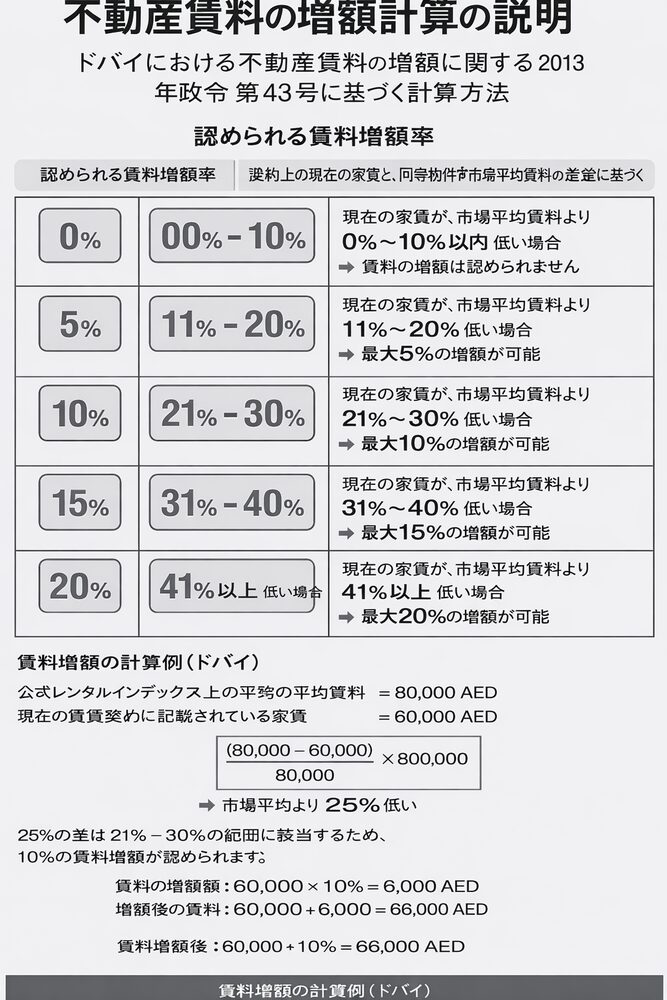
The increase rate is determined by the gap between your current rent and the market average. If your current rent is close to or only slightly below the market average, no increase is allowed. The larger the gap between your rent and the market average, the higher the permitted increase rate becomes in stages, but it cannot exceed the upper limit set by law. Any increase exceeding the rate determined by the rental index is a violation and illegal.
Basic rule
The further your current rent is below the market average, the higher the rent increase rate permitted by law. (ABD Advocates)
Rent increase rates permitted by law
The upper limit is determined by the gap between the current rent and the market average rent. Also, simply by entering your property information into the Rental Index, it automatically shows whether a rent increase is possible and the increase rate. You don't need to calculate it yourself.
Let's look at an example. As shown in the image below, after entering the tenancy contract information for a certain rental property, you can confirm that the rent can be increased by up to 10%.
If they demand an increase of more than 10%, you can refuse.
Let's look at another example.
For this rental property, it shows "No Increase." Even though it clearly states that no rent increase will be applied at all, if they demand an increase, you can refuse.
Notice obligation before a rent increase
Even if the increase rate complies with the law, a landlord can only apply the increase if they have given the tenant written notice at least 90 days before the end of the contract. If they fail to meet this 90-day notice obligation, the landlord loses the right to increase the rent, and the rent stays the same as before upon renewal.
In what cases can a landlord demand eviction?
A landlord can demand that a tenant vacate the property only in limited legal cases. They cannot evict a tenant without a legitimate legal reason. One typical reason is when the landlord themselves, or a relative such as a parent, spouse, or child, uses the property for their own residence. In this case, they must prove that no suitable alternative property exists.
In addition, demolition or reconstruction of the building after obtaining the necessary permits, or major renovations that cannot be carried out while the tenant remains in residence, also allow eviction, provided there is a certified technical report. Furthermore, the sale of the property after meeting certain rules is also one of the lawful reasons for eviction.
Alternatively, the landlord can evict the tenant if they fail to pay rent, sublet without the landlord's permission, use the property for illegal or non-contractual purposes, cause serious damage to the property, or use it in a way that violates the contract or public order and morals. Even then, however, they must first issue a formal legal notice, and only if the tenant fails to remedy the situation within the deadline can they proceed through the Rental Dispute Settlement Centre (RDC).
On the other hand, evicting a tenant simply because the landlord wants to raise the rent, doesn't like the tenant, or has found another tenant willing to pay higher rent is not allowed. Also, even when there is a legally legitimate reason for eviction, the landlord cannot change the locks, cut off electricity or water, or remove belongings without permission; only the authorities can carry out the forced enforcement of an eviction.
What if a landlord demands eviction claiming "I'll live there myself" but doesn't actually live there?
In some cases, after evicting a tenant on the grounds of personal residence, a landlord does not actually live in the property. Dubai law is clear on this point.
If it is proven that the landlord has not lived in the property after the eviction, or if they soon rent it out to someone else or sell it, that eviction is judged to be illegal and unjustified. In such cases, the former tenant has the right to file a formal complaint and prove that the eviction reason was false. As a result, the landlord may be obligated to compensate the tenant and bear the legal costs and fees.
How long the landlord must actually live there
In practice, a landlord who evicts a tenant on the grounds of personal residence is usually required to actually live in the property for at least two years. Renting it out to a third party during this period is not permitted. Acting against this may be regarded as evidence of bad faith.
Legal procedures for demanding eviction

To make an eviction lawful, the landlord must send the tenant a formal notice via a notary public or registered mail. This notice must be written in Arabic. The notice must also be given at least 12 months before the end of the contract. The law prohibits unjustified eviction, and a tenant cannot be evicted unless there is a clear and provable legal reason.
What to do if the landlord forces through an illegal rent increase
If the landlord demands a rent increase that violates the law and the tenant refuses it, the tenant can proceed directly to the Rental Dispute Settlement Centre (RDC), even without the landlord's consent.
Phase 1
At this stage, you file an Offer & Deposit application. This is a procedure similar to an Ejari renewal, and you submit the following documents: the existing tenancy contract, the current Ejari, Emirates ID, a passport copy, and a copy of a new rent cheque prepared using only the legally permitted rent amount.
As for the rent cheque, rather than handing it to the landlord, you deposit the signed original cheque with the RDC. The RDC keeps the original as evidence of your intention to pay, and the copy is treated as part of the application documents. Once this procedure is complete, the RDC can renew and register the Ejari on behalf of the tenant, even without the landlord's cooperation. The cost of this phase is about AED 700 (approx. USD 190).
Phase 2: Amicable settlement (mediation)
(Approximately 3% of the annual rent) If the landlord continues to object even after the Offer & Deposit, the RDC usually moves to an amicable settlement (mediation) phase before going to court. In this phase, the RDC intervenes as a neutral mediator and, after giving formal notice to the landlord, checking documents, and verifying the RERA rent index, aims to reach a resolution without a judge's ruling.
The purpose of this stage is to resolve the matter as early as possible and avoid a full trial. The cost is about 3% of the annual rent amount and is incurred separately from the AED 700 of Phase 1, but it is significantly lower than court costs. If the landlord agrees at this stage, the legitimate rent amount is fixed without going to court, and the procedure ends.
Phase 3: RDC trial (formal litigation procedure)
If the landlord does not respond even in the mediation phase, the case proceeds to a formal RDC trial (litigation procedure). In this phase, a judge makes a ruling, and the cost is usually about AED 10,000 (around USD 2,700). However, if the tenant wins, this court cost is generally refunded, and the court officially fixes the legitimate rent amount based on the RERA rental index. In practice, when the documents are in order and the increase is clearly illegal, rulings are often made in the tenant's favor.
Summary
Dubai law regulates the landlord-tenant relationship in a well-balanced way. Rent increases and evictions are permitted by law, but clear conditions and procedures must be followed. By both parties observing these rules, disputes decrease and a more stable, fair relationship can be built.
Recommended reading: 9 Things You Should Know Before Renting in Dubai: A Complete Guide for Expats