

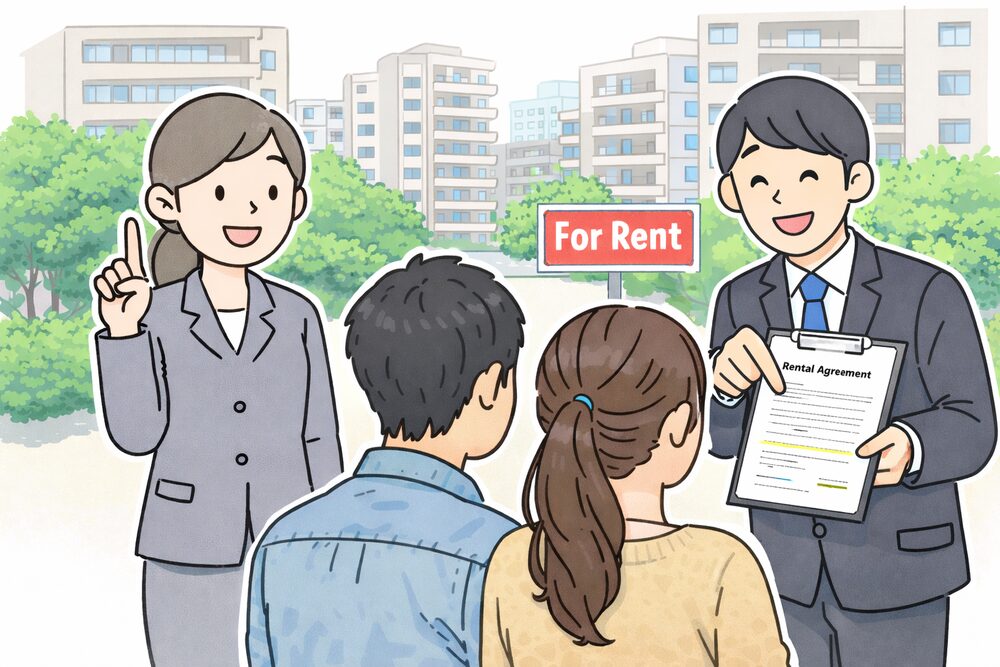
A summary of the points you'll want to know before signing a rental contract in Dubai
Searching for a home in Dubai may work a little differently from what you're used to back home, and it can be confusing at first. Please note that the points introduced here are aimed at those considering a long-term rental of around one to two years.
Advice on short-term rentals of six months or less is scheduled to be published soon, so please be sure to check back.
We'll explain step by step, focusing on the points where many tenants tend to stumble. After reading this, you'll be able to search for a home with peace of mind even in your first time living in Dubai.
Table of Contents
1. DEWA (Electricity & Water) / How long until DEWA is available / About Dubai's Housing Fee
2. Internet (Wi-Fi)
3. Air Conditioning (AC / Chiller)
4. About Gas and Hot Water
5. Security Deposit
6. Ejari — Tenancy Registration Guide
7. About Real Estate Agency Fees
8. Does Rent Go Up Every Year?
9. Can You Negotiate Rent?
Summary
1. DEWA (Electricity & Water)
Electricity and water in Dubai are managed by DEWA. The monthly cost is roughly 300–600 AED.
Who registers?
→ The tenant themselves
When to register
→ Be sure to register before moving in (without DEWA, you can't use electricity or water)
How to register
→ Via the DEWA app or website; the process takes about 5 minutes
How long until DEWA is connected?
If you apply for DEWA after completing your Ejari registration:
- Usually connected within 4–24 hours
- In some cases connected within just a few hours
- If an inspection is required, it can take up to about 48 hours
* Depending on when the previous tenant canceled, connection may be faster.
About Dubai's Housing Fee
Also, in Dubai a charge called the "Housing Fee" is included in your monthly bill. This is like a public-service usage fee that residents pay to the Dubai government; it is usually calculated as 5% of the annual rent and billed in monthly installments together with DEWA (electricity and water charges).
Those living in Dubai for the first time are often surprised, but the Housing Fee is a common cost paid by all residents, so it's reassuring to remember it as a fixed cost required in addition to rent.
2. Internet (Wi-Fi)
In Dubai, almost every home requires an internet contract. The typical monthly cost is 280–400 AED.
Who registers?
→ The tenant themselves
Providers
→ Etisalat or Du
Timing
→ Before or on the day of moving in (you'll need to be home for the router installation)
3. Air Conditioning (AC / Chiller)
In Dubai, there are two types of air-conditioning charge systems.
✔ Chiller Free
A type where cooling costs are included in the rent.
✔ Non-Chiller Free
A type where cooling costs are billed separately.
Key points
- The larger the home, the higher the cooling costs
- Some companies charge a "Minimum Charge"
- In older buildings, or in many villas and townhouses, AC costs may be included in DEWA
Examples of chiller companies
Empower / Emicool / Tabreed / Alpha Utilities
Who registers?
→ The tenant themselves (only if not Chiller Free)
4. About Gas and Hot Water

The way gas and hot water work in Dubai may be quite different from what you're used to back home. Here we've clearly summarized the points you'll want to know before moving in.
About Gas in the Building
Buildings with pipeline gas (central gas)
Some buildings have gas supplied throughout the entire building (Pipeline Gas). In this case, tenants need to register with a gas company. Major gas companies:
- Emirates Gas
- Lootah Gas
You can use the gas only after the gas company activates the meter and performs a safety check. Without registration, you can't use the gas stove.
Buildings without pipeline gas
If there is no central gas supply, it will be one of the following:
Gas cylinder (LPG)
A gas cylinder is delivered to your home. Major delivery companies:
- Emarat
- ENOC
- ADNOC Distribution
If you call, they will come to replace the cylinder.
Induction / electric stove
Some buildings come with an electric stove installed, so a gas contract may not be needed.
About Hot Water
In Dubai, most homes have an electric water heater.
In the case of an electric water heater
- It becomes usable automatically once DEWA (electricity) is activated
- Hot water comes out within a few tens of minutes after turning it on
Buildings with a central hot-water system
In newer buildings, there is a system that produces hot water centrally and supplies it to each home, and some types require no water-heater operation inside the home.
Summary
- Central gas available → registration with a gas company is required
- No central gas → gas cylinder or electric stove
- Hot water is mostly electric, though some buildings have central hot water
5. Security Deposit

This is a deposit paid before the contract.
- Unfurnished property: 5% of the rent
- Furnished property: 10% of the rent
* The amount can vary depending on the property, but this range is generally the guideline.
Who do you pay?
→ The owner only
* As a rule, real estate companies do not receive the security deposit.
However, if the agent or real estate company holds a formal Power of Attorney (POA) from the owner, and that POA explicitly states "authority to receive the deposit," then the agent can receive it on the owner's behalf.
Points to check
- Title Deed
- The owner's passport or EID
* Always check that the name and unit number match.
6. Ejari Registration
This is the system for officially registering a rental contract in Dubai.
- Registration by the tenant themselves is required
- Also essential for DEWA connection
- Can be easily registered via the Dubai REST app
- Completed entirely online
7. About Real Estate Agency Fees
First year: Agency Fee
When you rent through an agent, an agency fee is usually charged in the first year. The standard is around 5% of the annual rent (some agencies apply a minimum fee). Always confirm the exact amount in advance.
From the second year onward
If you renew with the same property, an agency fee is often not charged again. This is one reason many people stay long-term.
8. Does Rent Go Up Every Year?
Rent increases in Dubai are not unlimited — they are capped by law (Decree No. 43 of 2013). The allowed increase is set in five bands from 0% to 20%, depending on how far your current rent sits below the market average calculated by the RERA rental index.
The landlord must also notify you in writing at least 90 days before the contract ends if they intend to change the terms. You can check the official allowed increase yourself using the RERA Rental Index (the Dubai REST app).
9. Can You Negotiate Rent?
Yes. Rent negotiation is common in Dubai. A particularly effective tactic is the number of cheques: paying the annual rent in fewer cheques (e.g. 1–2 instead of 4–6) often gives you room to negotiate a lower price.
It also helps to research the market rate for similar units in the same building or area beforehand, and to point to comparable listings when you negotiate.
Summary
Renting in Dubai comes with its own way of handling utilities, the Housing Fee, Ejari registration, AC/chiller charges and the cheque system. Once you understand these points in advance, the process is smooth. If you have any questions about finding a home in Dubai, please feel free to contact us.